
New French requirements for wooden packaging material used for transport of goods
Background
Defra have recently become aware of new French requirements relating to wooden packaging material (WPM) accompanying imports of sanitary and phytosanitary goods (SPS goods) to France, which are due to apply from Tuesday 1 September 2026.
The measures appear to be national controls introduced by Service d'Inspection Vétérinaire et Phytosanitaire aux Frontières (SIVEP) in response to an outbreak of pine wood nematode (Bursaphelenchus xylophilus) in the Landes region.
Due to this outbreak, checks on wood packaging material from third countries have been significantly strengthened by France. Defra and colleagues within the Forestry Commission have contacted the French National Plant Protection Organisation (NPPO), to seek further clarification on the requirements.
Based on the information currently available:
- existing requirements for all wooden packaging material (WPM) used for goods imported into France remain unchanged. WPM must continue to be marked in accordance with ISPM 15 standards, confirming that the material has been heat treated or fumigated. Any WPM currently being used to export relevant goods to France should already comply with these requirements
- the key change is that all wooden packaging (including pallets, crates and similar packaging) accompanying goods subject to SIVEP controls will require a CHED-PP notification through TRACES, alongside the existing ISPM 15 marking requirements. This is in addition to any existing CHED pre-notification required for the commodity being exported
- the requirement is for the person responsible for the goods to make the TRACES CHED-PP declaration for the wooden packaging and include the separate treatment plant numbers marked on the wooden packaging
- for consignments of animal origin products, Official Veterinarians should not be asked to certify wooden packaging requirements
What is meant by goods subject to SIVEP controls?
This currently includes goods that already require one of the following notifications:
- CHED-A (Live Animals)
- CHED-D (Feed and food of non-animal origin intended for animal feed)
- CHED-PP (plants and plant products)
- CHED-P (Products of Animal Origin)
- NoA (Notification of Arrival)
Additional categories
Defra are currently seeking further information on the scope of these requirements, including whether they apply to any additional categories of goods beyond those listed above. Defra will provide further updates as more information becomes available.
Information to be declared in Part 1 of the CHED
The process for submitting WPM information is different depending on which commodity is arriving at the French point of entry.
The different CHEDs are as follows:
CHED-A for the importation of live animals, including equines, poultry, and livestock.
CHED-P for products of animal origin (POAO), germinal products, animal by-products (ABP), and certain composite products.
CHED-PP for regulated plants, plant products, seeds, and other items subject to phytosanitary controls – including used agricultural or forestry material, wood and wood products including WPM (see below).
CHED-D specifically for high-risk feed and food products of non-animal origin that are subject to increased controls.
NoA notification of arrival alerts customs and veterinary authorities prior to cargo reaching a border control post
Process for CHED-A, D, P or NoA
Please follow these steps to submit WPM information
1. Request CHED-PP authorisation for TRACES-NT
- to be able to submit a CHED-PP, Part I. The person responsible for the load (PRFL) must be authorised by the importing competent authority in the EU member state
- until this is complete the person responsible making the CHED-PP will be unable to create a new CHED-PP
- this should be done in advance of the consignments arrival to avoid delay.
2. Complete CHED-A, D or P
- complete your respective CHED or NoA as normal e.g. CHED-P, CHED-D, CHED-A
- you are unable to notify WPM through the CHED-A, CHED-D and CHED-P journeys on TRACES-NT
3. Raising a CHED-PP for WPM
- You can clone the original CHED information into a CHED-PP or manually enter the information again. The operator is required to clone the DSCE-A/P/D or NoA to a CHED-PP. This procedure, described below, can be carried out regardless of the status of the DSCE-A/P/D or NoA in question, whether it is ‘new’, ‘in progress’ or ‘validated’.
The operator selects the ‘Clone as CHEP-PP for WPM’ tab in ACTION:
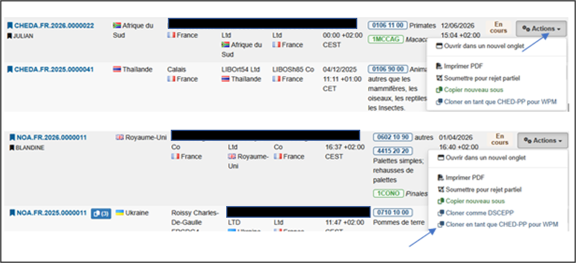
Then follow the process in adding WPM information to a CHED PP. If you are unable to clone, follow the steps below:
2. consider which scenario below applies:
1. You know the commodities accompanying your WPM
When selecting the commodities via commodity codes, in the pop-up window select the option 'Other than plants or plant products'. This will provide further commodity codes that can be selected that aren’t normally associated with CHED-PP. At the commodity level (box I.31 - Description of the goods) add the WPM in box - I.31 – Wood packaging
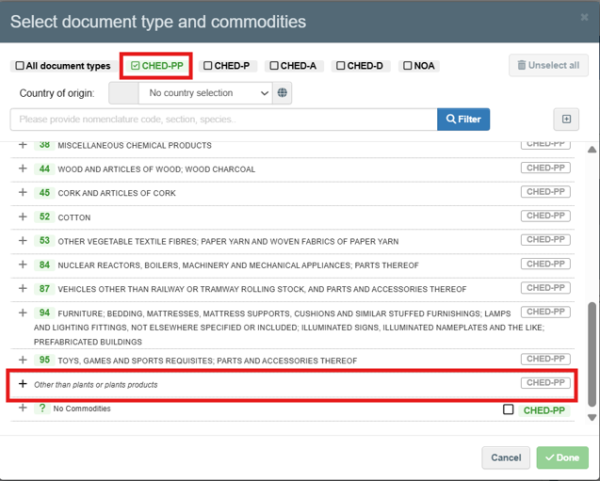
2.You do not have the information for the commodities accompanying your WPM
Select the option 'No commodities'… at the level of box – I.31 – Description of the goods, you will have an empty box.
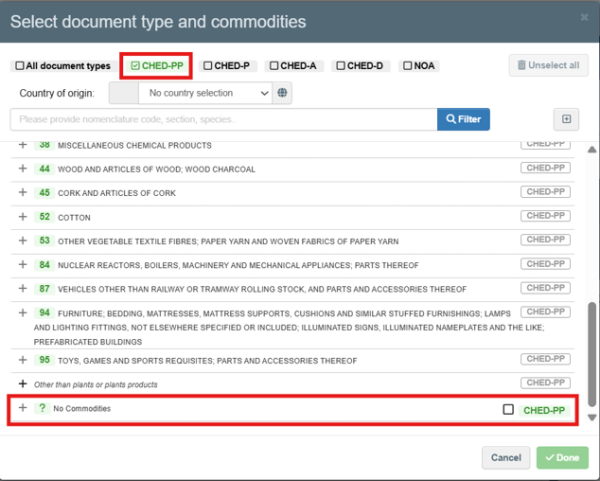
3. You are only exporting WPM as a commodity e.g. empty pallets
Select the CN code (4415).
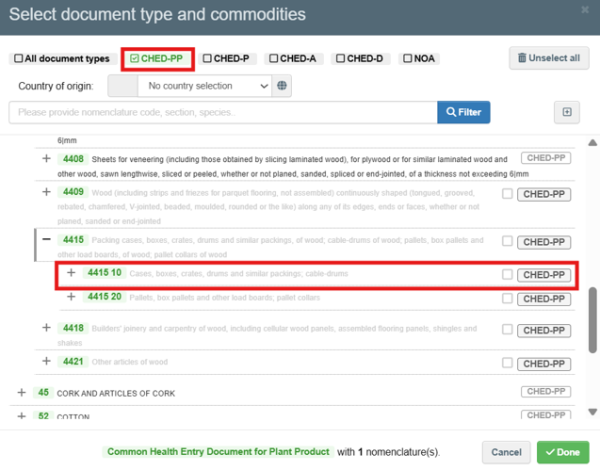
4. Adding WPM information to a CHED-PP
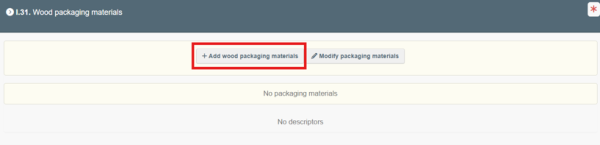
In box I.31 of the CHED-PP, select “+ Add wood packaging material”.
For the selection of CN code: 4415, the following information must also be provided. Failure to do so may result in your goods being delayed at the French border.
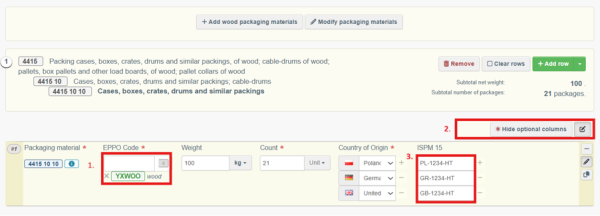
Please note the following information:
- A list of EPPO codes will appear from the drop-down menu, select the most appropriate
- Select ‘show optional columns’ to show ISPM 15 field
- Data must follow this format XX-XXXX-XX (production number may be several digits long)
Please complete the following fields:
- EPPO code 2WPMA (this relates to wood packaging material)
- Net weight
- Number of units
- Country of origin: This is the origin of the WPM, this may be different to the Country of Origin (CoO) of your goods. Multiple CoO can be added.
- ISPM15: This is the two-letter ISO code of country - producer code- treatment applied e.g. GB-1234-HT. This is the mark that will appear on the WPM if it has been appropriately treated.
You can go back and modify any fields before submission by clicking ‘modify packaging materials’
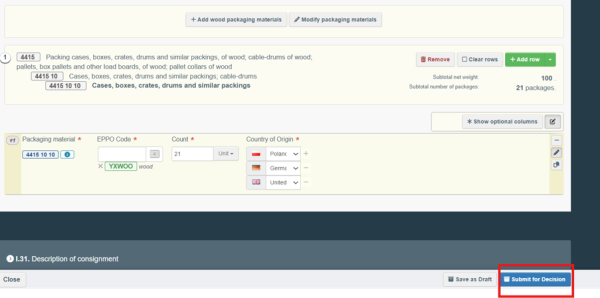
Once all the mandated fields for the CHED-PP have been completed you can submit the CHED for a decision using the blue button highlighted below.
Further information on how to complete a CHED-PP can be found on the European Commission’s website
Process for CHED-PP
Please follow these steps to submit WPM information:
- complete the CHED-PP as normal, including the WPM details as highlighted below
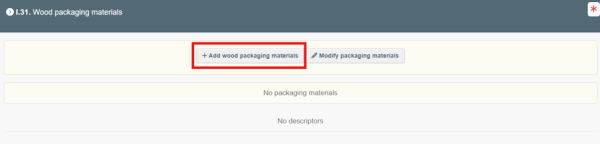
- to add WPM information to a CHED-PP, in box I.31 of the CHED-PP, select “+ Add wood packaging material”
3. For the selection of CN code: 4415, the following information must also be provided. Failure to do so may result in your goods being delayed at the French border.
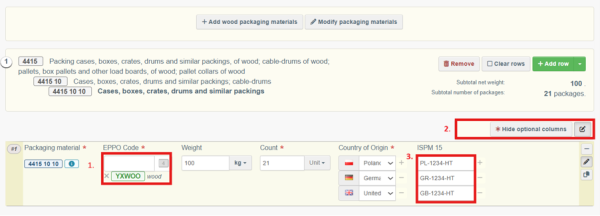
Please note the following information:
- A list of EPPO codes will appear from the drop-down menu, select the most appropriate
- Select ‘show optional columns’ to show ISPM 15 field
- Data must follow this format XX-XXXX-XX (production number may be several digits long)
Please complete the following fields:
- EPPO code 2WPMA (this relates to wood packaging material)
- Net weight
- Number of units
- Country of origin: This is the origin of the WPM, this may be different to the CoO of your goods. Multiple CoO can be added.
- ISPM15: This is the two-letter ISO code of country - producer code- treatment applied e.g. GB-1234-HT. This is the mark that will appear on the WPM if it has been appropriately treated.
You can go back and modify any fields before submission by clicking ‘modify packaging materials’
Once all the mandated fields for the CHED-PP have been completed you can submit the CHED for a decision using the blue button highlighted below.
Further information on how to complete a CHED-PP can be found on the European Commission’s website
FAQs
What is the requirement for WPM?
All WPM moving between GB and the EU must meet ISPM 15 international standards by undergoing heat treatment and marking. All WPM may be subject to official checks either upon or after entry to the EU or GB. This requirement is already in place for WPM moving between non-EU third countries, and the EU, and UK.
What products does WPM refer to?
Wood packaging material (WPM) includes:
- pallets
- crates
- boxes
- cable drums
- dunnage
What is ISPM 15?
The International Standard for Phytosanitary Measures 15 (ISPM 15) sets out measures required to reduce the risk of the introduction and spread of pests associated with wood packaging material (WPM). For GB, this requires all WPM (bar exceptions) entering and leaving GB to be treated and marked.
Are there any exemptions?
Whilst there can be exceptions to the exempted products listed below, depending on the country of origin and the type of wood used in the product manufacture, the following articles are generally regarded as being of sufficiently low risk to be exempt from ISPM 15 requirements:
- wood packaging material made entirely from thin wood (6 mm or less in thickness)
- wood packaging made wholly of processed wood material, such as plywood, particle board, oriented strand board or veneer that has been created using glue, heat or pressure, or a combination thereof
- barrels for wine and spirit that have been heated during manufacture
- gift boxes for wine, cigars and other commodities made from wood that has been processed and/or manufactured in a way that renders it free of pests
- sawdust, wood shavings and wood wool
- wood components permanently attached to freight vehicles and containers
An exclusion also applies to dunnage which is associated with consignments of controlled timber ‘associated controlled dunnage’. This applies to means which supports a consignment of wood and is of the same genus or species specified in the entry declaration and which:
- is constructed from wood of the same type and quality as the wood in the consignment; and
- meets the requirements specified
How do I ensure my WPM is compliant?
Contact your supplier or TIMCON if you need more advice about sourcing ISPM 15 compliant WPM.
Is the CHED-PP required for every shipment?
If the goods being imported are subject to sanitary and phytosanitary (SPS) or plant health controls, a CHED-PP must be submitted for any regulated wood packaging material (WPM) accompanying the consignment.
What codes should be included and legible on my WPM to ensure it’s compliant?
To be compliant with ISPM 15, WPM needs to have been officially marked with the ISPM 15 stamp consisting of three codes (country code, producer code and the treatment applied) and the International Plant Protection Convention (IPPC) symbol.
Will there be new checks on WPM moving from GB to the EU?
All wood packaging material (WPM) moving between GB and the EU must be treated and appropriately marked in compliance with international standards (ISPM 15). This is in line with international requirements for trade and is in place to protect both the EU and GB from harmful plant pests and diseases. In addition, France has introduced new requirements for the notification of WPM associated with goods subject to SIVEP controls and may be subject to physical inspection.
We occasionally export empty pallets. How do they fit into this process - are they the same as any other goods?
Pallets and other solid wood packaging are treated slightly differently to other wood products. The ISPM 15 mark applies to the movement of pallets whether they are in use or not and, for exporting empty pallets, the ISPM 15 mark replaces the need for an export phytosanitary certificate. From a biosecurity perspective, since the end of the transition period, all wood packaging material (WPM) moving between GB and the EU must be treated and appropriately marked in compliance with international standards (ISPM 15).
Do ISPM 15 pallets need to be heat-treated again before they are reused?
Once a pallet is heat-treated and marked according to ISPM 15 international standards then it can be re-used without requiring further heat-treatment.
The only situation when further heat-treatment may be required is in the event the pallet needs to be repaired and/or remarked. Under these circumstances the pallet may be repaired with heat-treated timber and re-marked by the repairer, or the whole pallet may be re-treated and re-marked according to the way that ISPM 15 requires.
Are CC trolley shelves exempt from requiring am ISPM 15 stamp?
Generally, yes as wood components permanently attached to freight vehicles and containers are generally regarded as being of low risk and are exempt from ISPM 15 requirements. This exemption extends to the shelves of CC trolleys. You should however check with the importing country before exporting your consignment.
If importing goods not subject to official controls regulation (OCR) in France and importing into France on pallets etc, must you raise a CHED-PP for the wood packaging? Or does this only apply to imports subject to OCR?
If the goods being imported are subject to sanitary and phytosanitary (SPS), a CHED-PP must be submitted for any wood packaging material (WPM) accompanying the consignment. Where goods are not subject to SPS, there is currently no requirement to submit a CHED-PP solely for the wood packaging material associated with those goods.
Is there an option to submit a single declaration at consignment level, rather than providing HT reference numbers for each pallet individually?
No, for every CHED you are required to provide a reference number for every item of WPM with the CHED.
We have been advised that both our organisation and the EU-based importer must be registered and approved as plant health operators in TRACES. Can you confirm whether this is correct?
The person responsible for the consignment in TRACES must be authorised to submit a CHED-PP before the goods arrive in France. Failure to do so may result in delays to the consignment at the border.
The consignor (exporter) should be validated in TRACES. However, the absence of consignor validation does not prevent the submission of a CHED-PP, provided that the person responsible for the consignment has the necessary authorisation to complete the declaration.
For full-load consignments, will SIVEP unload the entire shipment to verify the HT reference numbers? If so, who is responsible for any damage that may occur to the goods or packaging during the inspection process?
The unloading and reloading of goods at the French border are a matter for the French competent authorities. Any questions regarding inspection procedures, including the handling of consignments and the treatment of goods that are damaged during official controls, should be directed to SIVEP, which is responsible for carrying out these checks.
What contact details are available for the authorities responsible for carrying out these specific checks?
Should you have any concerns or require further information, please contact SIVEP, the authority responsible for carrying out these checks.
If non-compliant material is found what will happen with my goods?
If any non-compliant material is found at the point of import the French competent authorities will advise you on next steps. If the SPS goods as well as the non-compliant WPM are to be returned to GB then a pre-notification as part of the returned goods policy will need to be provided on IPAFFS. You will not be required to make an additional CHED-PP for the WPM.
Is there anything I can do to prepare my consingments for WPM inspections?
In order to facilitate these checks, operators should also be made aware of the need to organise the loading of goods or animals into containers or lorries in such a way that the markings on wooden packaging are immediately visible when the container or vehicle is opened.